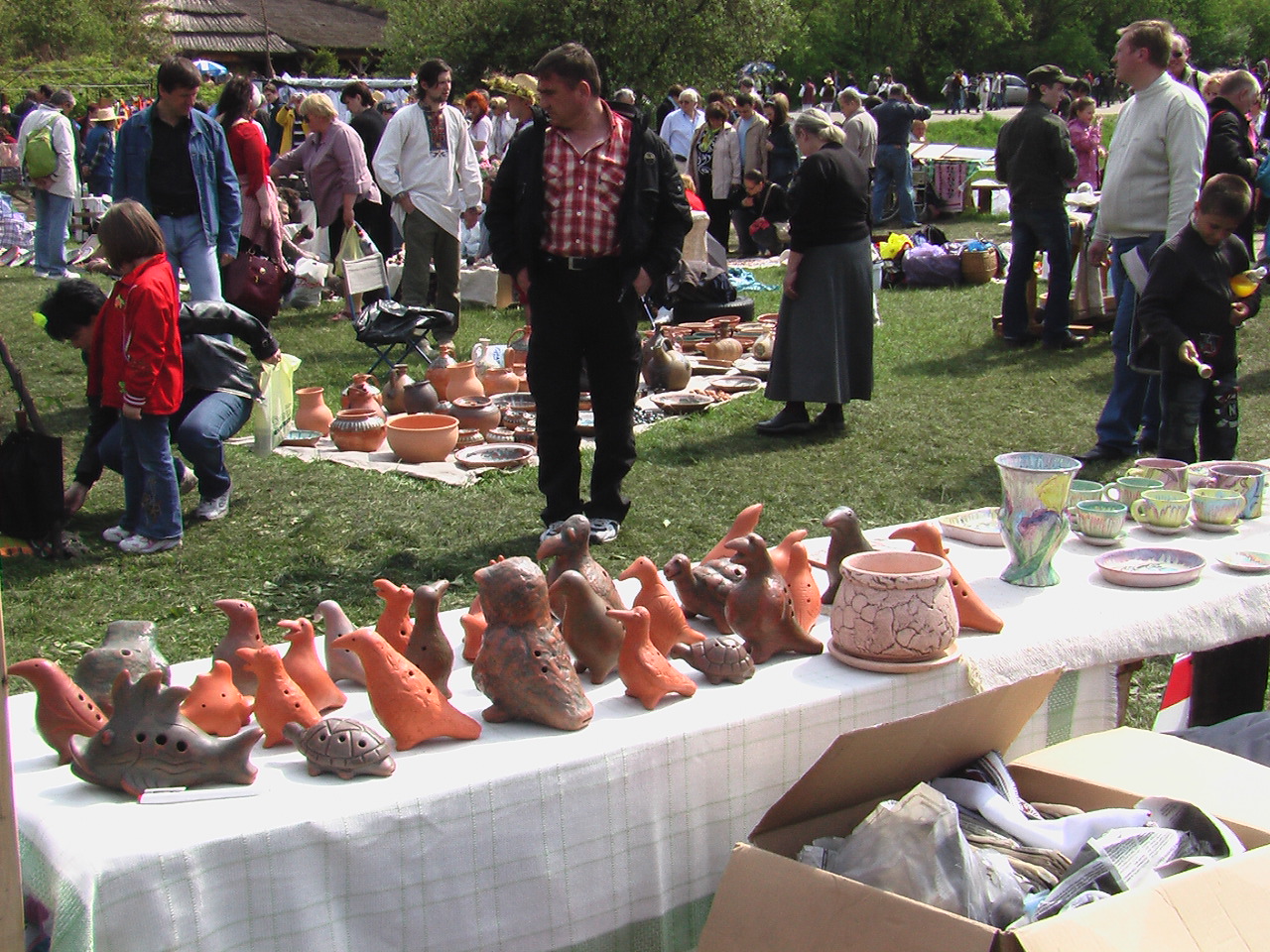
Roman Mytskan is an artist known for his unique approach to sculpture. His works are distinguished not only by their form, but also by their ability to interact with the viewer. He believed that sculpture that not only stands but also “plays” has a special power. For Mytskan, creating this type of art was an expression of creative experimentation, where every element had meaning and every detail could evoke new sensations.
The idea that sculpture can be musical seems paradoxical to the traditional understanding of this art form, but Mytskan embodied it in his works. For him, the combination of sculpture and ocarina was the embodiment of true ceramics. Because a stone sculpture is silent, and a ceramic ocarina plays. Roman Mytskan combined this in one entity. He tried not just to make a static form, but to create an object that has movement and sound, and thus becomes alive. His ceramic sculptures are not just material, but a whole world that conveys emotions and sensations through texture, color, and form.
Mitskan's large ceramic works not only looked good, but also sounded good. They were “musical instruments” that required the participation of the viewer. The sculptures were not closed objects. They interacted with space and even with people who, by touching them, could evoke certain sounds, thus creating a kind of symphony of material and sound.
This photograph shows several such works, which combine flexible lines, dynamism, and elegance. The sturdy yet light-looking forms seem to move, creating a sense of lightness and flexibility, even though they are made of solid ceramic. The structure of the sculpture is not just linear — it draws the viewer into a space where one can feel a slight vibration or breath that seems to come from the material itself.
Such works require deep immersion in the creative process. Every stroke, every change in form could open up a new possibility for the birth of sound, so that the sculpture is not just an object, but becomes part of a musical composition. Mytskan himself repeatedly emphasized that it was important for him not only to create a form, but also to give it a voice so that it would come to life in interaction with space and people.
We can imagine how each of his works could have its own special “song.” In those large-scale forms, there is a rhythm that can change depending on how a person perceives the sculpture, how they interact with it. And everyone who touched this work became part of its music.
Such creative masterpieces are extremely important for the development of contemporary art, as they open up new horizons for expression. Roman Mytskan has managed to combine not only form and content in his sculptures, but also sound, creating a true harmony between matter and emotions, between silence and music. His works are a dream of objects that can talk to us, play with us, and perhaps even dance with us.
An important feature of these works is not only their form, but also how they convey the concept of living art. Mitskan did not simply create static works; he sought to establish a dialogue between the viewer and the object, between solid material and an intangible idea. And this dialogue continues, even if the sculpture does not move, because its forms, its lines, its “rhymes” continue to resonate in memories and thoughts.
Roman Mytkan left us a legacy that not only impresses with its external beauty, but also expands our understanding of what sculpture is and how it can influence a person. His works are not just objects for contemplation, they are objects that carry a powerful potential for emotional and intellectual perception.