Ceramics is one of the few technologies that not only accompanied civilization, but also brought it together. Clay is everywhere, but ceramics only appear where humans have learned to control fire: not a bonfire in the wind, but heat collected in a chamber, contained by walls, fueled by draft, repeated over and over again. This is no longer an element. It is technology. And where technology arises, culture arises too — in the truest sense of the word.
For Ukraine, this story is not an abstraction from a textbook. In our lands, ceramics very early on became a systematic endeavor, rather than a random craft “in case of need.” This is evidenced by archaeological finds, the density of cultural layers, and the scale of the ceramic heritage preserved today in Ukrainian museums. In particular, the collections of the National Museum of Ukrainian History in Kyiv, the funds of the Institute of Archaeology of the National Academy of Sciences of Ukraine, and the collections of regional museums in Podillia, Naddniprianshchyna, Volhynia, and Galicia. This is not just one “beautiful culture,” but a long technological line that spans millennia.
The most famous early peak of this line is the Trypillian culture, which dates back to approximately 5400-2700 BC. This is not a short episode, but almost three thousand years of development. Trypillia is often shown through pottery: large forms, rich ornamentation, rhythmic spirals, combinations of red, black, and white. But archaeology gives a broader picture. There are small plastic arts, details of everyday life, cult objects. And, importantly for us, there are decorations. Ceramic beads are so common in Trypillia complexes that it is difficult to explain them as a coincidence or a one-off fashion. This means one simple thing: clay jewelry was a real and widespread element of the material world.
Beads are very indicative of the level of craftsmanship. They are small but demanding. Poor preparation of the clay, air bubbles, uneven drying — and the small object will crack before it even reaches the kiln or will burst inside it. If the firing is “floating,” the bead will either be undercooked and brittle, or it will overheat, warp, and become deformed and defective. It is small plastic and small jewelry that best demonstrate that the master already knows how to maintain the technology consistently. Therefore, a ceramic necklace is not a “trifle.” It is a concentrate of knowledge.
In ancient times, the firing temperature depended on the type of kiln and how the process was organized. The simplest hearths and pit kilns often reached temperatures of around 600-900°C. Well-designed kilns could reach 900-1000°C and maintain the heat longer and more evenly. This is critical for ceramics: it is not only about the peak temperature, but also about time, stability, and repeatability. In fact, repeatability is the beginning of technology. And this is what transforms clay into a cultural material.
This is where ceramics becomes a bridge to metal. Bronze is an alloy of copper (90%) and tin (10%), and it does not arise simply from the desire to “mix metals.” Bronze requires a culture of high temperatures: a furnace, air supply, the ability to work with heat, a crucible, a mold, and an understanding of how the material behaves when molten. The melting point of bronze alloys is usually around 900-1050°C, and for reliable melting and casting, craftsmen kept the temperature around 1000-1150°C. This is a different risk zone, a different level of responsibility. But the principle is the same as that practiced by ceramists for centuries: control the heat, don't rely on it.
In the Bronze Age, copper was relatively accessible in many regions, but tin was scarce and strategic (Britain, Afghanistan). This created long trade chains, where a rare resource traveled hundreds and thousands of kilometers. And that is why the Bronze Age is so closely associated with exchanges: routes, contacts, the “great roads” of the ancient world. Tin could come from distant areas, and any disruption in supply affected entire regions. In such a system, ceramics did not disappear. On the contrary, it was the infrastructure of the craft. Crucibles, casting molds, nozzles, furnace elements, technical details — all of this was made of ceramics or serviced by ceramics. Ceramics literally held metallurgy “in its hands.”
And now for the most interesting part of the topic of necklaces. Jewelry always responds to the availability of materials and what society considers prestigious. In different eras, jewelry sets changed in Ukrainian lands. In the early Iron Age, during the time of the Cimmerians (approximately 9th-7th centuries BC), ceramic beads were increasingly replaced by other materials: stone, metal, organic materials, and later glass. This did not mean the “death of ceramics.” It meant a change in fashion, symbols, and economics. Where a new resource and new prestige appear, jewelry changes as well.
In the Chernyakhov culture (approximately 3rd-5th centuries AD), we see another shift. Glass beads become widespread. Coral appears as a status material. And coral is already a direct marker of long-distance trade and inclusion in a broad exchange system. It is not taken “near the settlement.” It comes through the channels where the market, politics, route security, and contacts between regions operate. At this point, the necklace becomes more than just jewelry. It becomes a document of the era. It shows who you are connected to and what world you live in.
Here, it is important to add another strong Ukrainian accent that is often underestimated. During the Rus period, ceramic beads once again made a noticeable “explosion” in material culture. Rus is an era of cities, crafts, trade, fairs, and specialization. It was a time when artisan quarters developed, workshops operated, and everyday life became more complex and richer. In such conditions, ceramics could not be secondary. It once again became widespread and necessary. Ceramic beads were a natural extension of this artisan base: affordable, easy to produce, stylistically diverse, and recognizable.
Ceramic beads in Rus are also important because they show the development not only of technique but also of taste. Jewelry always says more about society than it seems. It shows that people have time and a need for beauty. It shows that there is exchange, there is a market, there is a craftsman, there is a buyer. It shows that culture is no longer struggling for survival on a daily basis, but knows how to live more broadly. And in this sense, ceramic beads are a marker of the development of our ancestors' cultures no less than weapons, buildings, or coins.
If we look at history soberly, ceramics in Ukraine has never been “just tableware.” It was a technology that taught people to control temperature. It was a material that shaped everyday life. It was a craft that created cities and economies. It was a language of ornamentation in which the world was read. And it was a decoration that touched the body and made culture personal.
That is why ceramic beads have a special significance. A bead is a small unit of civilization. It passes through the hands of a master, through drying, through the kiln, through heat, through the risk of cracking, through strength testing. It comes out of the kiln no longer as clay, but as ceramics — a material that remembers fire. And when there are many such beads, it means that society is able to repeat a complex process over and over again. It means technological discipline. And the discipline of technology is civilization.
At Mytskan Family Ceramics, we do not treat necklaces as “ethnic souvenirs” or stylized antiques. We work with them as a real continuation of the Ukrainian ceramic line. We understand that the kiln is the heart of the craft. We know that ceramics does not forgive accidents. We know that a bead is always honest: either it has endured or it has not. And that is why it has power.
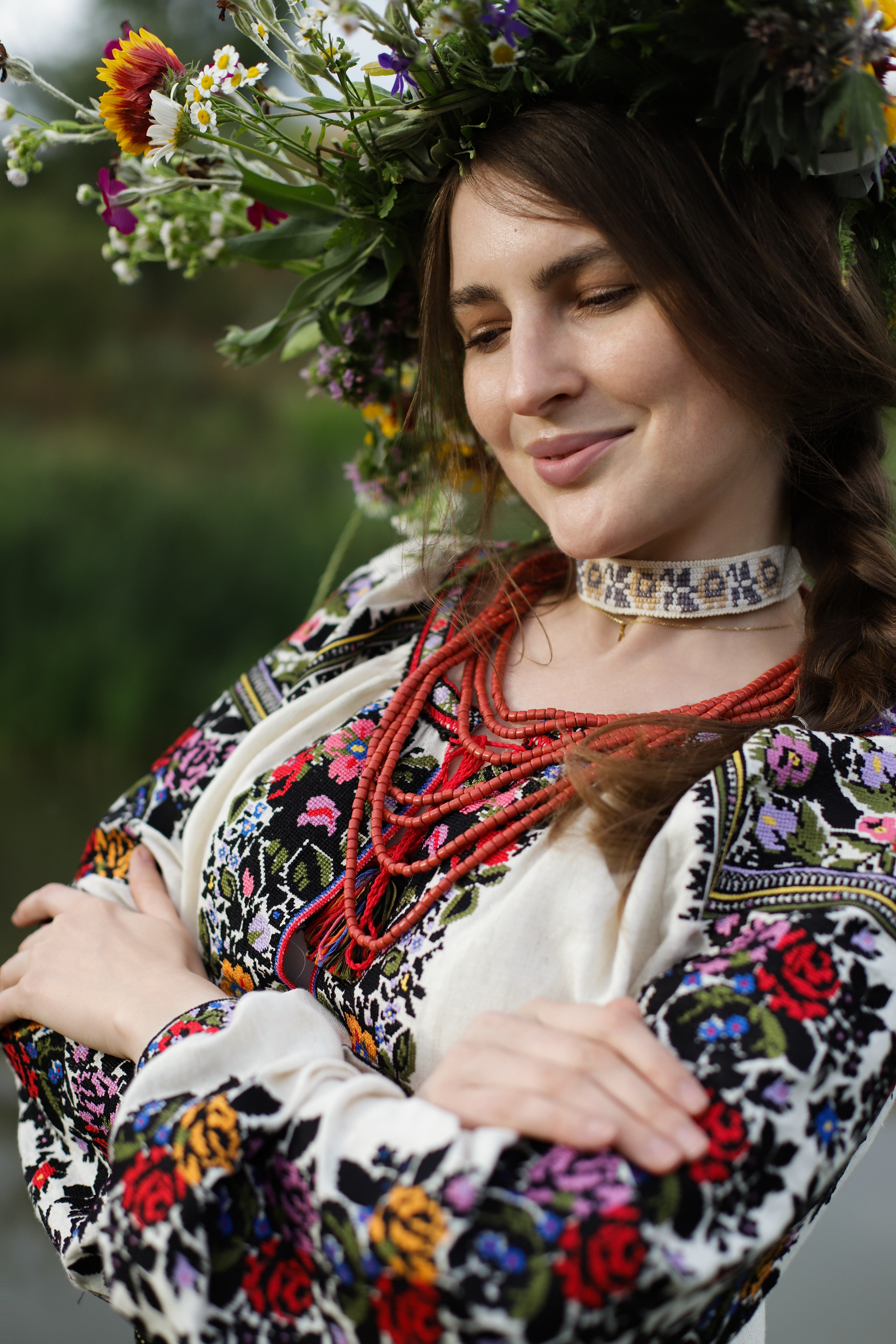
When a Mytskan ceramic bead is placed around your neck today, it brings with it not a legend, but the technological memory of this land. It carries the experience of Trypillia, where clay was a culture. It carries the knowledge of the kiln that made bronze a reality. It remembers the changes of eras when jewelry materials came and went with trade, wars, prestige, and fashion. It remembers Rus, where ceramics once again became a mass sign of developed life. And it brings all this back to the present with one simple gesture: to be on a person, to warm themselves with their body, and to live side by side every day.
Ceramics can truly be called the mother of civilization. Because it taught humanity to control fire. And the necklace is its most human proof. Not on a museum wall, not in theory, not in a diagram. On the neck. In motion. In life.