
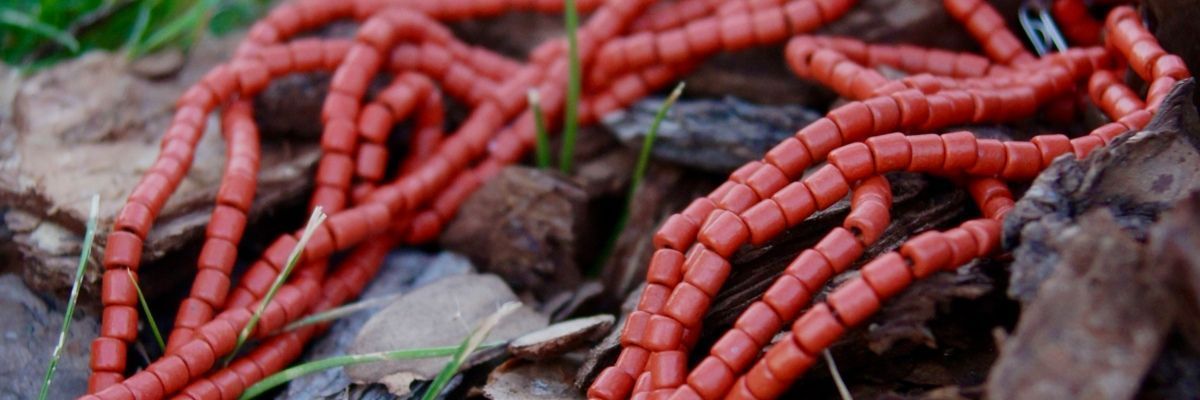
Among the shadows of spruce trees, where grasses whisper at night and fog drifts among rocks and moss in the morning, ancient history lives on, mixed with clay like bread in memory. There, in the mountainous region, where water remembers the names of ancestors and every stone has a voice, we, the Mytskans, practice our craft like a magical ritual that has continued for decades.
What we do is not just ceramics, it is a ritual. These are not just necklaces, they are amulets created from ancient matter, from the very soul of the earth.
My father, Roman Mytskan, founder of the family business, like a molfar, took clay in his hands — living, malleable, warm, like the heart of an unborn world. It is not a material, it is a spirit. It breathes, resists, whispers ancient legends that only those who know how to listen can hear.
Clay must be obtained, not bought, not ordered, but found, dug up, torn from the bowels of the earth, with respect and patience. In Kosovo, Kolomyia, Khimchyn, Slavensk, or Chasiv Yar, among the hills and springs, the master searches for the one that speaks to him. It is different—hard, deaf, melodious—and each requires a different touch, a different prayer.
Clay must “rest,” like a dream. For a week, two weeks, a month, it stands in silence, breathing, cleansing itself of the noise of the world, in order to begin a new life. At this time, it is not disturbed, only observed to see if it has stirred, if it is ready to say “yes.”
And when it finally matures, then the kneading begins. The master's hands are not hands, but tree roots. They feel everything: temperature, tension, even mood. Clay either listens or it doesn't. And if it doesn't listen, you have to negotiate with it, like with a child, like with a spirit.
Form is born from nothingness: first from emptiness, from the touch of the great void. Each bead is a grain of history, a drop of memory, molded in silence. There are many of them — hundreds, thousands, each unique, like a star in the night sky.
Colors are magic. Red is like blood, remembering love. Black is like night, when souls wander. Green is like leaves, hiding ancient shadows.
Enamel is the skin of a product, its aroma, its voice in the world.
And then the furnaces. Majestic, dark, burning, like the mouth of some prehistoric dragon. They are lit at night, because it is at night that fire most resembles the spirit. The flames breathe. The fire hisses. It tests.
Clay meets fire - it's like an initiation. It screams. It cracks. It cries - and survives. And something else emerges from the fire: something stronger, real, filled with inner light. Or it doesn't emerge. The kiln breaks and the clay can be ruined.
Firing is not just a technology, it is an ancient act of purification and transformation. It is like in myths: a hero enters hell and returns from there as a god. Similarly, clay, which was soft and unstable, becomes eternal through fire.
My dad spent forty years searching for the right recipes and the right proportions. He seemed to have found them all, but he always said there was still so much more to discover.
When the beads cool down, they are strung together. Not just on a thread, but on a soul. This is no longer a product. It is a song, a prayer, a talisman.
Wearing them means carrying something more than just jewelry. It is protection. It is a bridge. It is a link between the past and what is yet to come.
Women wear these necklaces and are transformed. Something profound awakens in each of them: the memory of their grandmother, the strength of their mother, the voice of the earth.
And children touch the necklaces and hear music. Because there is sound in every bead. Because their father was not just a craftsman, but a musician who worked with clay. He created not only form, but also sound, vibration, and inner tone.
His ocarinas, whistles, and musical sculptures are instruments, but also conductors. They connect this world and the other. They speak where words are silent.
And now, since my father is gone, my mother, who was with him from the very beginning, does it. I do it. My children do it. Three generations of ceramic magic! Three generations of living tradition.
Mitskan ceramics are a pulse. They are the vibration of hands that hold the earth, the sky, and memory.
They are the song of clay that remembers the touch of rain, the flight of birds, the trembling of the first humans.
They are not fashion, they are revelation.
They are not souvenirs, they are relics.
And at night, when the kilns breathe again and the master sculpts a new form, the shadows of forgotten ancestors gather once more in a dance. They touch the hot ceramics, shake their heads, and disappear into the darkness.
Because they know: they are remembered. They are carried on. They are recreated by the hands of the living, the hearts of the masters.
Each necklace is like a word in a song that is no longer sung, but lives on in the blood.
Each form is like a mark on clay that cannot be erased.
And the master is only a guide. His eyes see what others miss. His hands speak to those who are long gone.
The Mytskan family is not a dynasty. It is a temple.
And each necklace is a prayer.


